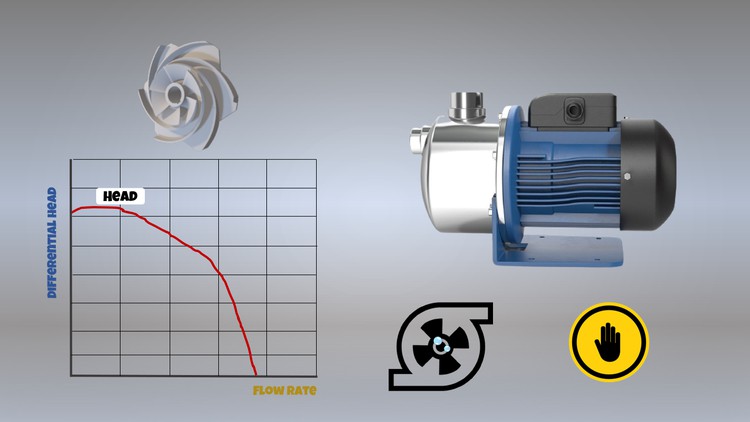
Pump Basics: Principles, Operation and Design

- Description
- Curriculum
- FAQ
- Reviews
Pump is a device that expends energy in order to raise, transport or compress fluids. According to its classification, pumps are used differently to impart energy to the fluid. The basic methods are:
– Volumetric displacement
– Addition of Kinetic energy
– Use of Electromagnetic force
“Pump Basics: Principles, Operation and Design” Training Course will help you learn about the different pump types, their operation and working principles. As the course is compact it aims to deliver only practical and as well as necessary information about various types of pumps and their selection.
First, you will start the course with a short introduction to pumps and then will continue with pump classification lecture. Then, you will spend some time to learn about Pump Head and its effect on selection. After learning about the pump head and its derivation, you will get into the most essential parameter affecting pump performance and therefore its design and selection – Cavitation. We will spend more time on “Cavitation Phenomenon” to provide better understanding, as this topic is one of the mostly asked questions in work interviews.
As you got familiar with the essential parameters, you will get into the Centrifugal and Reciprocating Pumps, separately, to learn their specific types and working principles. These valuable information set will be followed by Pump Performance Curves, where we will help you learn about:
– How to construct Pump System Curve
– How to read Pump Performance Curve
– How to use both System and Performance Curves to control the operation
– What is the effect of NPSH on a process and
– How it is illustrated via Performance Curve
The practical sessions will be followed by another essential lecture of “Multiple Pumps in Operation”, where we will discuss:
– Pumps operated in series
– Pumps operated in parallel
– Why do pumps are operated in series/parallel?
– What is better choice and etc.
As you have landed the page to preview this training, please feel free to take part in the course as there is 30-day money back guarantee in case of irrelevant and inappropriate information delivery. Moreover, our development and instructors team are always ready to answer your questions relating to the course material. So, in case of any need for help from our side, please do not hesitate to contact us via e-mail or Q&A section.
So, are you ready? Let us get started!
-
2
 Classification of Pumps
Pumps are classified into two groups according to their capacity and how they impart energy to the fluid. In this lecture, we will briefly talk about:
- Centrifugal Pumps and
- Positive Displacement Pumps;
-
3
Major Pump Types
As you got introduction with the "Classification of Pumps" session, we can go over the major pump types. Here in this video, we will:
- Learn about various pump types;
- Differ them by operation and working principles and
- Understand the basics of various types
-
4
Pump Head and Selection
One of the essential pump performance contributor is pump head, which directly affects its performance and therefore selection. This lecture is dedicated to:
- What is pump head?;
- How is it calculated and
- How does it affect the pump performance
-
5
Cavitation in Pumps
In addition to Pump Head, other pump performance contributor is Cavitation, which directly impacts the pump internals and operation. This lecture will help you understand:
- What is Cavitation?;
- How is it related to NPSH, net positive suction head?
- How does the cavitation affect the pump performance
-
6
Calculation of NPSH
Another essential pump performance contributor is Net Positive Suction Head, NPSH, which impacts the cavitation probability, which in turn affects the pump performance. This video aims to help you learn about:
- How to calculate NPSH?;
- Relationship between NPSH and pump performance curve and
- What is the impact of NPSH on pump performance
-
7
Centrifugal Pumps
The mostly utilized industrial type is Centrifugal Pump, which imparts a centrifugal force to the fluid for increasing the pressure of it. Via "Centrifugal Pumps" lesson, you will get into:
- The working principles and operation of this type and
- Types of centrifugal pumps
-
8
Centrifugal Pump Performance Curves
After learning about pump head, cavitation phenomenon and NPSH factors, we can move on to the Centrifugal Pump Performance Curves, which includes:
- Impact of Flow rate and Required Head on Pump Performance Curve;
- How pump performance curves are used to monitor pump operation and
- The relationship between pump performance and system curve to find out an operating point of the pump
-
9
Cavitation on Performance Curves
As two essential pump performance contributors, importance of cavitation on pump performance curve is undeniable. In this lesson, we will lean about:
- Why is cavitation important on pump performance curve and
- How does changing NPSH affect the pump performance
-
10
System Curve and Capacity Control
As Pump Performance Curves are developed by vendors, system curves are more likely to be constructed by Engineers. Therefore, Pump System Curve and Capacity Control using both system and performance curves are essential. This session aims to go over:
- What is pump system curve?;
- How is constructed, read and developed and
- How to control pump capacity using system and performance curve relationship
-
11
Pump Capacity Control Example
After learning about pump system curve and capacity control using that, it would be better to work on Pump Capacity Control example, which will help you identify the importance of system curve on capacity control.