Electronics course for Arduino and pi Students (+Projects)
A solid foundation for Arduino and Raspberry pi programming students

- Description
- Curriculum
- FAQ
- Reviews
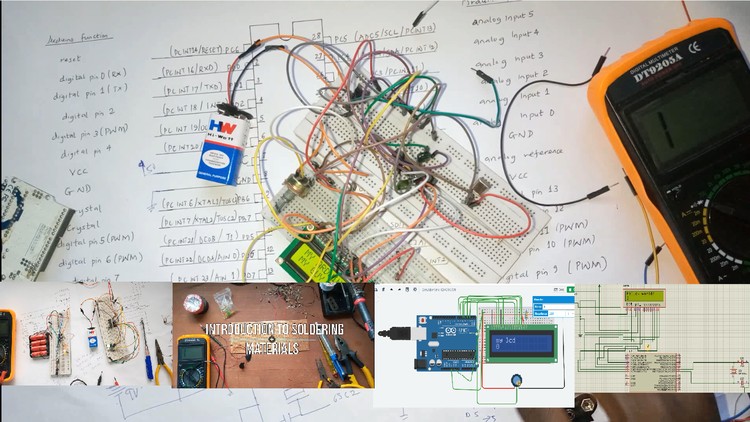
We believe Arduino and Raspberry pi programming is very easy to understand on your own if you have a good foundation in basic electronics. This course covers everything you need to know for you to become a hero in basic electronics. From resistor to Arduino programming, from breadboard to soldering. You will also learn how to use simulation Softwares, both online and offline. Enroll in the course now and understand the mysterious secrets of electronics. Meet you there!
Resistor
-
1
 Build your first circuit. ( The Software used will be shown soon)
 -
2
Introduction to Circuit Wizard
-
3
How to sign up tinkercad online simulation software
-
4
How to get Circuit Wizard and proteus installed
-
5
1-Build your first circuit
-
6
2-Circuit diagram, Schematic and pictorial circuit diagram.
-
7
Voltage and current
-
8
Common units and prefixes used in electronics
-
9
Materials needed
Multimeter
-
10
The relationship between Resistance, Voltage, Current
-
11
Application of Ohm's law and the definition of a resistor
-
12
Types of resistor
-
13
Resistor Color code
-
14
Tolerance
-
15
Resistor wattage
-
16
How to connect resistors in series
-
17
How to calculate the value of resistors in parallel
-
18
Limiting the flow of current with a potentiometer
-
19
Voltage divider
-
20
The relationship between R1 and R2 in voltage divider network
-
21
Using a potentiometer as a voltage divider
-
22
How to vary the value
-
23
More on variable resistor as a voltage divider
-
24
LDR in a voltage divider network
-
25
Voltage dropped across a resistor
-
26
Calculation of the appropriate value of resistor for a LED
-
27
Using thermistor in a voltage divider network
Breadboarding
Diode
Capacitor
Transistor
Logic Gates
Integrated Circuit
Relay
Transformer
Rectification
Voltage Regulator ICs
How long do I have access to the course materials?
You can view and review the lecture materials indefinitely, like an on-demand channel.
Can I take my courses with me wherever I go?
Definitely! If you have an internet connection, courses on Udemy are available on any device at any time. If you don't have an internet connection, some instructors also let their students download course lectures. That's up to the instructor though, so make sure you get on their good side!
Stars 5
3
Stars 4
0
Stars 3
0
Stars 2
0
Stars 1
0
Course available for 2 days
Course details
Video
17 hours
Certificate of Completion
Full lifetime access
Access on mobile and TV
Popular courses