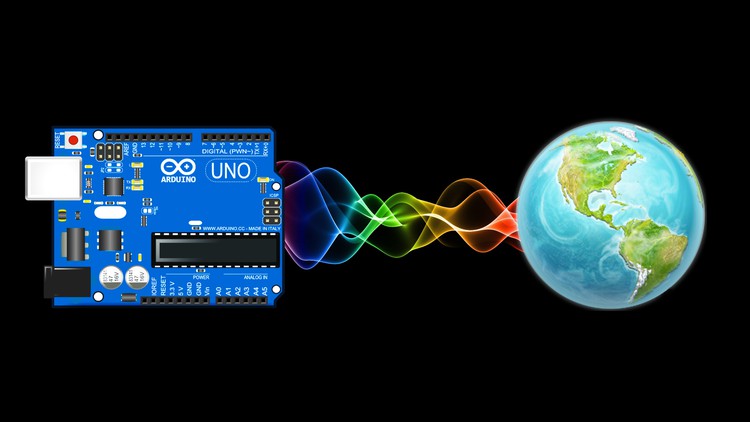
Crazy about Arduino: Your End-to-End Workshop - Level 1

- Description
- Curriculum
- FAQ
- Reviews
“The explanation is very clear, complete and to the point.” Richard C.
Very well thought out and presentation, informative.” Tony N.
****************************************************************************************
“What we can do with Arduino is only limited by our imagination!”
LEVEL 1
The best way to understand if this course is really for you is by asking yourself a few basic questions:
-
Do you like building “things” by yourself?
-
Are you looking for ways to easily combine software and hardware components?
-
Did you ever wonder how electronic devices are really working?
-
Do you have some creative idea and you just looking for ways to easily prototype it?
-
Would you be excited to monitor and control the physical world with a software program that you created?
-
Would you like to join the growing worldwide wave of Internet of Things Makers?
If the answer is “YES” for most of the questions above then you just landed in the right place. Arduino is probably one of the most amazing developments and prototyping platform today with endless possibilities for Do-It-Yourself Makers looking for ways to express their creative mind and technical capabilities.
It is really up to us, we can build simple and fun projects to very complex autonomous systems that can interact with users and help us to better bridge between the physical and the digital worlds.
This course is a starting point as part of a larger comprehensive training program divided into levels that are all about Arduino and the eco-system around it. Each course covers a specific group of subjects to let you develop and grow your skills in a step-by-step pace while enjoying the long journey.
Are you ready to start being “Crazy” about Arduino….? 😉
-
1
 Course Introduction
Welcome !
"Crazy about Arduino: Your End-to-End Workshop " is a new training program aiming to boost the innovation around the emerging opportunities coming with the wave of Internet Of Things, while using the Arduino development platform.
The training program is divided to several courseslevels, where each course is aiming to teach group of subjects related to Arduino in a fun and easy way. It is recommended to follow the program in the suggest sequence.
This course is Level 1 in the "Crazy about Arduino" program.
-
2
 Important Recommendation!
 -
3
What is Arduino ?
Arduino is an amazing easy to use development platform that bridge the physical world with the digital world.
In this chapter we will learn WHAT is Arduino and WHAT we can do with it ?
-
4
Endless Applications for Makers !
What kind of applications we can build with Arduino ? well, there are really endless applications we can build with Arduino.
Believe it or not, it is really limited by our imagination.... creative people around the world are creating innovative projects with Arduino.
-
5
Are you ready ? Software Checklist
We will need some specific free software tools and of course some small amount of hardware components.
-
6
Are You Ready ? Hardware Checklist
Before starting we need some specific software tools and some small amount of hardware components.
So what do you say, are you ready to start ?!
-
7
Introduction
In this section we will start to explore the Arduino features, functionalities and building blocks.
-
8
The Arduino Uno Board
Reviewing the Arduino Uno R3 board:
- Microcontroller
- Universal Serial Bus (USB) connector
- External power
- Reset button
- Light-Emitting Diodes (LEDs), labeled L, RX, TX, and ON
- Power connections
- Analog input
- Digital input and output
-
9
Other Arduino Boards
There are many types of Arduino boards available in the market, each with its own design, size and features that can be used to support different applications.
-
10
Expansion Shields & Modules
Each Arduino board has set of functionalities and based on some project’s requirements more options may be needed. In that case two main expansion options are available: Shields or Modules.
-
11
Arduino IDE
The developing platform for Arduino is called Arduino IDE and it is including: code editor, simple mechanism to verify and load programs, monitor the serial port, manage libraries and more. The software we create is called “Sketch” and the language syntax is similar to C & C++.
-
12
High Level Board Overview
Video demonstration of the Arduino Uno board, including an high level overview.
-
13
Running Our First Program !
In the previous two chapters we saw the Arduino IDE software tool and the Arduino Uno board. Now it is time to combine between them, meaning write some simple sketch, upload it to the board and see some result !
-
14
 Test your Knowledge : The Arduino Platform
-
15
Introduction
Writing an Ardunio software requires a little bit background in programming, if you already have it than it is going to be like piece of cake for you... and if you don’t.....don’t worry we will do it in step by step.
-
16
Sketching in Code
"Sketching in code" is all about trying things, letting our creative mind to flow, put less focus in that stage on making our code a perfect piece of art.... and more important build a step-by-step framework around your project.
"Big things have small beginnings"....
-
17
Basic Sketch Structure
Every sketch we will write or use is usually based on the following basic structure: variables declaration, setup function, loop function and custom functions.
-
18
Variables Declaration - Why ?
In almost all programs, we will probably need to store values, do some calculation, try to access specific pins numbers in Arduino and more. For that we can declare storage location that are called variables.
-
19
Variables Declaration - Data Types
While declaring a variable, we need to define the variable data type. The Arduino programming language support different very useful data types such as: Boolean, Byte, Char, Integer and more.
-
20
Variables Declaration - Naming Convention
Some of the names that we may chose may not be the most readable names...., which is why many programmers have adopted certain naming guidelines or conventions.
-
21
Variable Scope
The location of a variable declaration in a sketch actually determines where that variable can be used, or what is known as the variable scope. We have two types of variable scope: global variable and local variable.
-
22
Setup and Loop Functions
setup() is the first function the Arduino program reads, and it runs only once. The second function, loop(), makes it possible for our sketch to run continuously, and it will begins just after the last statement in the setup() function has finished executing.
-
23
Custom Functions
In programming it is common practice is to divide big tasks to smaller tasks using functions. A function is a block of code that performs a specific task that is repeating in program. Now instead of writing the same code all over again we can just call the function name... isn't that great ;-) ?
-
24
Operators
An operator is a symbol that tells the compiler to perform specific mathematical or logical functions:
- Arithmetic Operators
- Relational Operators
- Logical Operators
- Bitwise Operators
- Assignment Operators
- Misc Operators
-
25
Control Statements
Control statements enable us to specify the flow of our program. Using them we can make decisions in specific locations, or to perform tasks repeatedly or to jump from one section of code to another one.
There are two kinds of statements available in Arduino for controlling program flow:
- Conditional statements
- Iterative statements
-
26
Control Statements: if-else
if-else statement decides whether to execute another statement or decides which of two statements to execute.
If (You are Crazy about Arduino == TRUE) {
keepLearning(nextChapter);
}
-
27
Control Statements: switch
The switch statement is more complicated version of the if statement as it can execute one or more blocks of code, depending on a range of conditions.
-
28
Control Statements: for loop
For loop is an iterative statement that allows to repeatedly execute lines of code in a loop a specified number of times.
-
29
Control Statements: while/do loop
The while statement or while loop, is used to continuously execute a statement so long as specific condition remains true.
-
30
Using Libraries
One of the greatest thing in Arduino development environment is that it provide us an easy access to a very large amount of off-the-shelf ready to use functions that are grouped to libraries.
Why to re-invent the wheel ? we better invest in developing the next generation autonomous car.....
-
31
Comments in Code
Comments are used to document what’s going on in a program for anyone reading the code and should be used any time we wish to explain what a program or a specific function is supposed to do.
-
32
Test your Knowledge : Arduino Programming
-
33
Introduction
Learning by doing is probably the best way to really understand something while enjoying the process and the outcome of the final project.
-
34
Our Arduino Project
In the next sections we are going to build our first Arduino project. The project is divided to several steps enabling us to learn each main subject by itself.
It will be great! if you will build it also in parallel to the course.
-
35
Breadboard
In order to build a circuit, we have to connect circuit components together and a great tool for this purpose is the solderless breadboard. A breadboard is a simple prototyping plastic base board that easily allows us to wire up simple circuits without having to solder together parts to a custom printed circuit board.
-
36
Introduction
Short introduction to what we are planning to build in Step one.
-
37
Project Building Blocks
"Think before you do something" :-)
Before running into building the hardware and writing our software, let's review the main building blocks that are needed in this specific step.
-
38
Wiring LEDs
LEDs are one of the most-used components in many projects and as you probably know, LED stands for light-emitting diode. Like all diodes components, LEDs allow current to flow in only one direction.
LEDs are polarized components, meaning we need to carefully connect them in the right direction!
-
39
Reading Digital Inputs
Reading digital inputs will help us to interact our Arduino with the external environment in real-time. In our case we are going to use very simple digital sensors that are called push buttons.
To read the status of a button, we first need to define a specific digital I/O pin as an input and use digitalRead(pin) function, where pin is the digital pin number to read.
One thing that is important to add to this circuit is something that is called pull up or pull down resistors.
-
40
Pull Up/Down Resistors
The main usage of pull down resistor is to set the default state of the input pin to 0v. 10kΩ is a fairly common pull down resistor value.
-
41
Circuit Design
Let's review the circuit design for this step using the Fritzing tool. Don't forget that you can download the files templates from the relevant chapter.
-
42
Project Review: Step-1A
Let's review the hardware setup relevant to this step and the behavior of the system.
-
43
Sketching in Code: Step-1A
The Sketch is the software code that we uploaded into the Arduino board. Let's understand the logic and program flow we used in this step.
Don't forget that you can download the sketch files from this chapter !
-
44
Handling Switch Bouncing
When working with buttons, we cannot just look for the value of the switch to changed from low to high as we need to handle a problem that is called switch bouncing.
Buttons are mechanical devices that operate much more slower than our Arduino system. In other words, when we push a button down, the signal we will read does not just go from low to high, it bounces up and down between those two states for a few milliseconds before it settles.
-
45
Sketching in Code: Step-1B
The Sketch is the software code that we uploaded into the Arduino board. Let's understand the logic and program flow we used in this step.
Don't forget that you can download the sketch files from this chapter !
-
46
Project Review: Step-1B
Let's review the hardware setup relevant to this step and the behavior of the system.
-
47
Test your Knowledge : LEDs Test and Animation Wave
-
48
Introduction
Short introduction to what we are planning to build in Step two.
-
49
Project Building Blocks
"Think before you do something" :-)
Before running into building the hardware and writing our software, let's review the main building blocks that are needed in this specific step.
-
50
The Variable Resistor
In addition to fixed resistors there are also variable resistors or resistors that their resistance can be adjusted by physical rotation. One common type of variable resistor is the potentiometer. The potentiometer has three pin connections: one in the center pin and one on each side. When someone is turning the shaft of a variable resistor, it increases the resistance between one side and the center and decreases the resistance between the center and the opposite side.
-
51
Circuit Design
Let's review the circuit design for this step using the Fritzing tool. Don't forget that you can download the files templates from the relevant chapter.
-
52
Reading Analog Inputs
Reading analog inputs will help us to better interact our Arduino with the external environment around us, As many sensors are providing analog output when measuring some property, like distance, temperature, speed, light brightness and much more.
-
53
Utilizing the Serial Monitor
Serial communication is used by two digital devices to talk to each other and in our case the USB connection is the serial communication protocol. We already used it to upload our source code to the Arduino board.
Now, we can use the Serial Monitor included in the Arduino programming environment to actually “see” the values that the Arduino is reading from such external sensors.
-
54
Setting the LEDs Speed
While using the build-in delay function, “speed” will be measured in milliseconds and the relation is opposite, more delay is less speed. In that case some range normalization or mapping will be needed.
-
55
Sketching in Code: Step-2A
The Sketch is the software code that we uploaded into the Arduino board. Let's understand the logic and program flow we used in this step.
Don't forget that you can download the sketch files from this chapter !
-
56
Project Review: Step-2A
Let's review the hardware setup relevant to this step and the behavior of the system.
-
57
Writing Analog Output
For setting the LED brightness level we need to output a voltage between 0v and 5v. We can’t do it directly in Arduino but the good news is that we can “get very close”....
We can generate analog output values by using a method called PWM while using a function called analogWrite(). -
58
A little bit magic with PWM
PWM (pulse-width modulation) can be used to create the illusion of an LED being ON at different levels of brightness by turning the LED ON and OFF very rapidly, at around 500 cycles per second.
-
59
Setting the LEDs Brightness
Before using the AnalogWrite() function we need to do some value mapping.
-
60
Sketching in Code: Step-2B
The Sketch is the software code that we uploaded into the Arduino board. Let's understand the logic and program flow we used in this step.
Don't forget that you can download the sketch files from this chapter !
-
61
Project Review: Step-2B
Let's review the hardware setup relevant to this step and the behavior of the system.
-
62
Test your Knowledge : Control LEDs Speed and Brightness
-
63
Introduction
Short introduction to what we are planning to build in Step three.
-
64
Project Building Blocks
"Think before you do something" :-)
Before running into building the hardware and writing our software, let's review the main building blocks that are needed in this specific step.
-
65
The PIR Motion Detector
In physics, motion is a change in position of an object with respect to time and its reference point. A PIR sensor is a converter that measure a physical quantity (infrared radiation )and convert it into signal (ON/OFF).
-
66
Circuit Design
Let's review the circuit design for this step using the Fritzing tool. Don't forget that you can download the files templates from the relevant chapter.
-
67
Sketching in Code: Step-3
The Sketch is the software code that we uploaded into the Arduino board. Let's understand the logic and program flow we used in this step.
Don't forget that you can download the sketch files from this chapter !
-
68
Project Review: Step-3
Let's review the hardware setup relevant to this step and the behavior of the system.
-
69
Test your Knowledge : Motion Detector